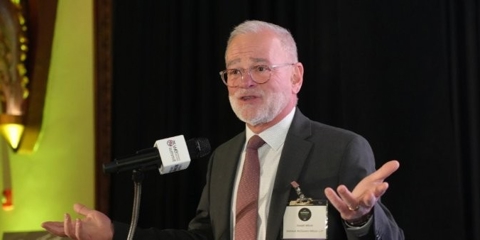
VMM attorney Thomas Weiss, head of the firm's Bankruptcy practice and key member of the Commercial Litigation, Real Estate Litigation, and Matrimonial & Family Law practices, wrote a guest column for "Rich's Sidebar"—"You can get your share of a jointly owned property even decades after a divorce."
"Rich's Sidebar" is a monthly column in Port Washington News by VMM partner Richard Apat, head of the firm’s Personal Injury and Real Estate Litigation practices.
"Rich's Sidebar" is also syndicated in other Gold Coast newspapers, including Long Island Press, Port Washington News, Manhasset Press, and Great Neck News.
These articles are designed to offer insights in a variety of areas, and occasionally feature other VMM attorneys as guest writers discussing other fields of expertise.

Rich’s Sidebar: You can get your share of a jointly owned property even decades after a divorce
By Thomas Weiss, Esq.
I do a lot of partition litigation. That’s when people own property together and can’t agree on its sale or division. It’s common when family members inherit property or sometimes after couples have divorced and didn’t divide their assets.
Sometimes, couples divorce without dealing with the distribution of their real property. The question then becomes, can you terminate your property interest and get your fair share of its worth, even years down the road? The short answer is: yes.
There’s no statute of limitations for the judicial partitioning of property. Absent an express agreement to the contrary (e.g., a prenup or postnup), a testamentary restriction against partition (e.g., a provision in a will that prevents inherited property from being split up), or extreme prejudice to a co-owner (e.g., if one spouse wishes to stay in the house and has a child with special needs but cannot afford to buy out their half, while the other seeks to force its sale), a partition is a co-owner’s right.
To put it another way, if the co-owner of a property no longer desires to hold or use it in common—regardless of how it’s been used and for how long—there’s generally no defense against partition.
Recently, I represented someone who was divorced from her ex-husband for over thirty years. Her ex wanted her to sign over a property they had co-owned, and sent her a deed and transfer documents.
When she contacted my office and I looked through her settlement agreement from the divorce, we discovered that the property was never distributed, meaning that, even after all these years, they still co-owned it.
The ex-husband argued, among other things, that it was too late for us to seek partition of the property; since he alone maintained the property and paid the expenses on it, and my client “sat on her rights” for too long, she was not entitled to an equitable share of the property.
After failed negotiation attempts, we commenced a lawsuit for partition. The court quickly ruled in our favor, establishing our right to partition of the property. After that, the ex-husband agreed to settle.
Had he settled the case earlier, he could have saved himself a lot of money. The final settlement was four times what my client was willing to settle for early on. But stubbornness, and ignorance of the law, are an expensive mix.
If you’re separated or divorced, even for a long time now, it’s always a good idea to have an experienced attorney look at your settlement agreement and any property or assets you owned jointly. You might be surprised.
Thomas Weiss heads the Bankruptcy practice at Vishnick McGovern Milizio LLP and is a key member of the Matrimonial & Family Law, Commercial Litigation, and Real Estate Litigation practices. He can be reached at tweiss@vmmlegal.com and 516.437.4385 x146.