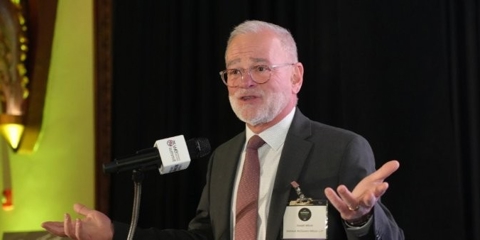
Partner Thomas Weiss, head of VMM’s Bankruptcy practice, was invited by Nassau Lawyer to write an article on "Understanding Subchapter V Small Business Bankruptcy: Eligibility, Process and Keys to a Successful Outcome."
Nassau Lawyer is the peer-reviewed journal of the Nassau County Bar Association. Mr. Weiss's article can be found in the February print edition, online here (pgs. 8–9), and below.
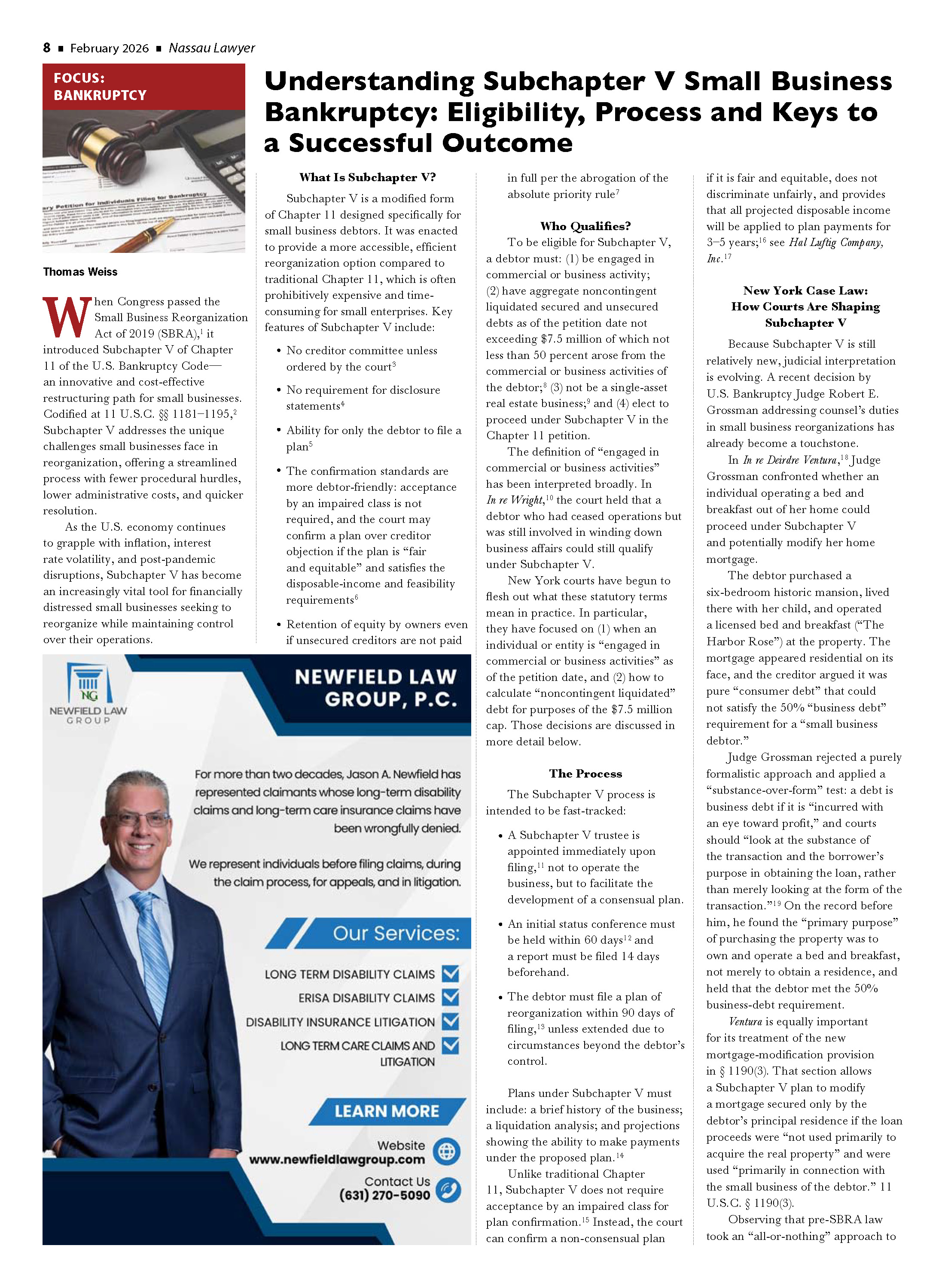
Understanding Subchapter V Small Business Bankruptcy: Eligibility, Process, and Keys to a Successful Outcome
When Congress passed the Small Business Reorganization Act of 2019 (SBRA)[1], it introduced Subchapter V of Chapter 11 of the U.S. Bankruptcy Code—an innovative and cost-effective restructuring path for small businesses. Codified at 11 U.S.C. §§ 1181–1195[2], Subchapter V addresses the unique challenges small businesses face in reorganization, offering a streamlined process with fewer procedural hurdles, lower administrative costs, and quicker resolution.
As the U.S. economy continues to grapple with inflation, interest rate volatility, and post-pandemic disruptions, Subchapter V has become an increasingly vital tool for financially distressed small businesses seeking to reorganize while maintaining control over their operations.
What Is Subchapter V?
Subchapter V is a modified form of Chapter 11 designed specifically for small business debtors. It was enacted to provide a more accessible, efficient reorganization option compared to traditional Chapter 11, which is often prohibitively expensive and time-consuming for small enterprises.
Key features of Subchapter V include:
- No creditor committee unless ordered by the court[3]
- No requirement for disclosure statements[4]
- Ability for only the debtor to file a plan[5]
- The confirmation standards are more debtor‑friendly: acceptance by an impaired class is not required, and the court may confirm a plan over creditor objection if the plan is "fair and equitable" and satisfies the disposable‑income and feasibility requirements[6]
- Retention of equity by owners even if unsecured creditors are not paid in full per the abrogation of the absolute priority rule[7]
Who Qualifies?
To be eligible for Subchapter V, a debtor must:
- Be engaged in commercial or business activity;
- Have aggregate noncontingent liquidated secured and unsecured debts as of the petition date not exceeding $7.5 million of which not less than 50 percent arose from the commercial or business activities of the debtor;[8]
- Not be a single-asset real estate business;[9]
- Elect to proceed under Subchapter V in the Chapter 11 petition.
The definition of "engaged in commercial or business activities" has been interpreted broadly. In In re Wright[10], the court held that a debtor who had ceased operations but was still involved in winding down business affairs could still qualify under Subchapter V.
New York courts have begun to flesh out what these statutory terms mean in practice. In particular, they have focused on (i) when an individual or entity is “engaged in commercial or business activities” as of the petition date, and (ii) how to calculate “noncontingent liquidated” debt for purposes of the $7.5 million cap. Those decisions are discussed in more detail below.
The Process
The Subchapter V process is intended to be fast-tracked:
- Trustee Appointment: A Subchapter V trustee is appointed immediately upon filing[11], not to operate the business, but to facilitate the development of a consensual plan.
- Initial Status Conference: Must be held within 60 days[12] and a report must be filed 14 days beforehand.
- Plan Deadline: The debtor must file a plan of reorganization within 90 days of filing[13], unless extended due to circumstances beyond the debtor’s control.
Plans under Subchapter V must include:
- A brief history of the business;
- A liquidation analysis;
- Projections showing the ability to make payments under the proposed plan.[14]
Unlike traditional Chapter 11, Subchapter V does not require acceptance by an impaired class for plan confirmation.[15] Instead, the court can confirm a non-consensual plan if it is fair and equitable, does not discriminate unfairly, and provides that all projected disposable income will be applied to plan payments for 3–5 years[16]; see Hal Luftig Company, Inc.[17]
New York Case Law: How Courts Are Shaping Subchapter V
Because Subchapter V is still relatively young, judicial interpretation is evolving. A recent decision by Judge Grossman addressing counsel’s duties in small business reorganizations has already become a touchstone.
In Deirdre Ventura[18], Judge Grossman confronted whether an individual operating a bed‑and‑breakfast out of her home could proceed under Subchapter V and potentially modify her home mortgage.
The debtor purchased a six‑bedroom historic mansion, lived there with her child, and operated a licensed bed‑and‑breakfast (“The Harbor Rose”) from the property. The mortgage appeared residential on its face, and the creditor argued it was pure “consumer debt” that could not satisfy the 50% “business debt” requirement for a “small business debtor.”
Judge Grossman rejected a purely formalistic approach and applied a substance‑over‑form test: a debt is business debt if it is "incurred with an eye toward profit," and courts should "look at the substance of the transaction and the borrower’s purpose in obtaining the loan, rather than merely looking at the form of the transaction."[19] On the record before him, he found the “primary purpose” of purchasing the property was to own and operate a bed‑and‑breakfast, not merely to obtain a residence, and held that the debtor met the 50% business‑debt requirement.
Ventura is equally important for its treatment of the new mortgage‑modification provision in § 1190(3). That section allows a Subchapter V plan to modify a mortgage secured only by the debtor’s principal residence if the loan proceeds were “not used primarily to acquire the real property” and were used “primarily in connection with the small business of the debtor.” 11 U.S.C. § 1190(3). Observing that pre‑SBRA law took an “all‑or‑nothing” approach to home mortgages, the court held that § 1190(3) instead directs a qualitative inquiry into the “primary purpose of the debt” and proposed a multi‑factor framework for determining whether a mortgage may be modified, including whether:
- The mortgage proceeds were used primarily to further the debtor’s business,
- The property is integral to the business,
- The property is necessary to run the business,
- Customers enter the property to utilize the business, and
- The business uses employees or local vendors in its operations.
Ventura thus illustrates both eligibility analysis for owner‑occupied businesses and the powerful, but carefully cabined, mortgage‑modification tool unique to Subchapter V.
In Christina Fama‑Chiarizia[20], Judge Garrity addressed whether an individual was "engaged in commercial or business activities" on the petition date where the underlying business had stopped operating years earlier and the debtor was primarily dealing with legacy litigation and a substantial judgment.
The court adopted the now‑prevailing view that "engaged in" is "inherently contemporary in focus," and that eligibility turns on whether the debtor is presently engaged in such activities as of the petition date.[21] But it also read “commercial or business activities” broadly, holding that:
Addressing residual business debt through Chapter 11, pursuing and defending litigation arising from former business operations, and actively marshaling business‑related assets (including through pending state‑court actions) can satisfy the engagement requirement, even though the underlying operating business (a construction company) had long since ceased trading. The court also found that the debtor’s longstanding rental of a portion of her two‑family home constituted a separate qualifying business activity, and it expressly rejected any requirement of a "nexus" between current business activities and the particular debts sought to be restructured.[22]
For practitioners, Fama‑Chiarizia is a useful roadmap for individuals with “legacy business debt” who are no longer operating a going concern but are still actively dealing with its financial fallout.
Debt Limits and “Noncontingent Liquidated” Claims
In Zhang Medical P.C.[23], Judge Wiles in the Southern District tackled the gatekeeping question of the $7.5 million debt cap. The landlord objected to the debtor’s Subchapter V designation, arguing that the debtor’s noncontingent liquidated debts exceeded the statutory limit.
Relying on Second Circuit precedent interpreting "noncontingent" and "liquidated" in the Chapter 13 context, the court held that a debt is noncontingent if "all of the events giving rise to liability" occurred prepetition, and it is liquidated if the amount is readily ascertainable "by reference to an agreement or by a simple computation."[24] Applying that framework, the court treated most components of the landlord’s large lease claim—unpaid rent, a rent‑credit “clawback,” a required replenishment of the security deposit, and related charges—as noncontingent and liquidated, even though future lease obligations remained open.
Adding the scheduled debts and the higher amounts reflected in proofs of claim, the court concluded that the debtor’s noncontingent liquidated debts far exceeded $7.5 million and sustained the objection.[25] Zhang underscores two practical points: eligibility disputes are highly fact‑driven, and the debtor bears the burden of showing that the statutory cap is not exceeded.
Keys to a Successful Subchapter V Case
1. Preparation is Crucial.
The debtor must make ongoing filings with the court concerning its profitability and projected cash receipts and disbursements through a monthly operating report.
Debtors should engage experienced bankruptcy counsel early, ensure accurate financial records, and prepare realistic projections. Courts have been skeptical of plans lacking credible financial data.[26]
2. Use the Trustee Effectively.
While the trustee’s role is more limited than in Chapter 13 or 7, the debtor is nonetheless subject to significant oversight by the trustee. Engaging early and timely complying with the trustee’s investigation can help build consensus with creditors and avoid contested confirmation.
3. Move Quickly.
Subchapter V’s expedited deadlines mean debtors must act decisively. The inability to meet the 90-day plan deadline without valid justification can lead to dismissal or conversion.
4. Address Creditor Concerns Proactively.
Even though creditor consent is not required, consensual plans avoid litigation and allow for smoother confirmation. Open communication and transparency with key creditors can facilitate this.
5. Understand the Plan Requirements.
The plan must commit all of the debtor’s disposable income for the applicable plan period and must be feasible. In re Body Transit, Inc.[27] emphasized that feasibility is key—even under Subchapter V, courts require realistic plans based on sound financial forecasting.
Conclusion
Subchapter V offers a powerful lifeline for small businesses burdened by debt but seeking to remain operational. Its streamlined procedures, reduced costs, and flexible plan requirements make it a compelling option for debtors who qualify.
However, successful outcomes depend on rigorous preparation, effective use of the trustee and legal counsel, and careful plan formulation. Courts have shown a willingness to support honest, diligent debtors—but will also dismiss or convert cases where the debtor fails to meet statutory obligations or attempts to misuse the Subchapter V process.
As the legal landscape continues to evolve, Subchapter V stands as one of the most debtor-friendly reorganization tools available—one that legal practitioners should fully understand and strategically deploy for qualifying clients.
Thomas Weiss heads the Bankruptcy practice at Vishnick McGovern Milizio LLP and is a key member of the Commercial Litigation, Real Estate Litigation, and Matrimonial & Family Law practices.
[1] Small Business Reorganization Act of 2019
[2] 11 U.S.C. §§1181-1195 Subchapter V of Chapter 11)
[3] 11 U.S.C. § 1181(b)
[4] 11 U.S.C. § 1181(b)
[5] 11 U.S.C. § 1189(a)
[6] 11 U.S.C. § 1191(b) and (c))
[7] 11U.S.C. § 1191(c)
[8] 11 U.S.C. § 101(51D)(A)
[9] As defined in 11 U.S.C. § 101(51B)
[10] 2020 WL 2193240 (Bankr. D. S.C. May 5, 2020)
[11] 11 U.S.C. § 1183
[12] 11 U.S.C. § 1188(a)
[13] 11 U.S.C. § 1189(b)
[14] 11 U.S.C. § 1190(1)
[15] 11 U.S.C. § 1191(b)
[16] 11 U.S.C. § 1191(c)
[17] Docket No. 22-11617 (Bankr. S.D.N.Y. Dec 7, 2023)
[18] Docket No. 8-18-77193 (Bankr. E.D.N.Y. Apr 10, 2020)
[19] Id.
[20] Docket, No. 1-21-42341 (Bankr. E.D.N.Y. Sep 15, 2023)
[21] Id.
[22] Id.
[23] 655 B.R. 403 (Bankr. S.D.N.Y. 2023)
[24] Id.
[25] Id.
[26] In re Ellingsworth Residential Community Ass'n, Inc., 619 B.R. 519 (Bankr. M.D. Fla. 2020).
[27] 613 B.R. 400 (Bankr. E.D. Pa. 2020)